Choosing an SEO marketing company is often seen as one of the most important yet intimidating decisions a business owner faces. It’s often compared to choosing a navigator for a long journey because of its lasting impact on your business.
A good SEO partner can turn your website into an automated lead machine. But if you pick the wrong one, you risk wasting money, months of frustration, and even damaging your website’s reputation with search engines.
The challenge is that SEO is complex, and it often seems like you need to already understand SEO to know how to hire an SEO agency.
This guide is here to help you see past the hype of so-called experts and find a partner who will bring real, measurable results.
What SEO Actually Is (and What It Isn’t)
Before we delve into how to choose an SEO agency that is right for your business, it’s important to understand what SEO really is and what it isn’t. Without that clear idea, it’s easy to fall for the tricks of self-proclaimed gurus.
What SEO is:
• SEO is the strategic process of improving your website’s visibility on search engines like Google, Bing, and Yahoo to reach your target audience.
• It’s a continuous effort, not a quick fix/one time fix, or a simple checklist. Search engine algorithms are constantly changing. What worked last year often won’t work today.
• Today’s SEO is a mix of art and science, requiring creative content that appeals to people and technical optimization to satisfy search engine algorithms.
• In 2025 and 2026, SEO has expanded into Answer Engine Optimization (AEO). The goal of AEO is to optimize content so it can be cited as a trusted source in AI-generated answers such as ChatGPT, Perplexity, and Google’s AI Overviews/AI Mode.
What SEO isn’t:
• It’s not a “secret trick” or an “overnight success” method. It often takes six months to a year to see significant results. If you are doing local SEO and the competition is low, some improvement can be noticeable within three months.
• It’s not about gaming the system or doing keyword stuffing; search engines now emphasize Experience, Expertise, Authority, and Trustworthiness (E-E-A-T).
• High traffic/High ranking is a “vanity metric” if it comes from keywords with no search intent or relevance to your business.
• No ethical SEO agency can guarantee a specific position because Google’s algorithm is a “black box” influenced by hundreds of uncontrollable factors.
• Unlike Google Ads, which gives instant, targeted traffic on a pay-per-click basis, SEO offers a sustainable, cost-effective way to attract quality visitors over the long term. Combining SEO with paid advertising often yields the best results for most businesses.
How To Hire An SEO Agency For Measurable Results
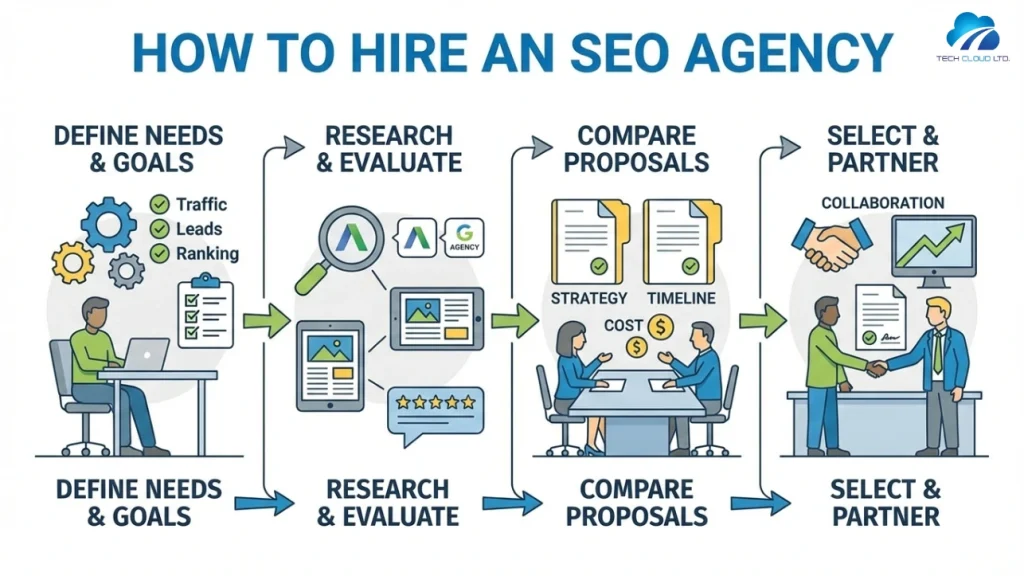
Selecting the right SEO agency might seem complex, but it’s not impossible or too difficult if you follow the recommendations below:
1. Clarify Your Business Goals and SEO Expectations
Before you talk to any SEO agency, it’s really important to know exactly what you want to achieve. Don’t just say “I want more traffic.” Think about real goals like getting a target amount of relevant traffic, increasing calls from potential customers, or boosting sales directly from your website.
Use SMART goals, so they’re clear and trackable—specific, measurable, achievable, relevant, and time-bound. Also, pinpoint who you want to reach, like “founders of tech companies.” When you’re clear, SEO experts can tell if your goals are doable and what steps to take.
Note: SEO differs from Conversion Rate Optimization (CRO). While SEO primarily drives targeted traffic with conversion potential, actual conversions depend on factors like your website’s user experience, product or service offerings, and brand reputation.
2. Assess Your Current Website and SEO Situation
Before you move forward, it’s important to take a good look at where your website and SEO stand right now. Knowing where you currently stand allows you to set realistic goals for the next 6 or 12 months. You don’t need to be an expert to check your organic traffic. You can use tools like Google Analytics 4 and Google Search Console that make assessment easy.
A solid SEO partner will kick off with a thorough audit to spot technical issues and see how you stack up against competitors. Watch out for any agency that tries to sell you a plan before checking out your site’s specific problems and the competition.
3. Set a Realistic SEO Budget
SEO is a long-term commitment, and you need to allocate a budget that supports your campaign for at least six to twelve months to achieve significant results. Typically, monthly SEO investments correspond to the size of your business:
- Small local businesses: $500–$1,500 per month
- Mid-sized businesses: $1,500–$5,000 per month
- Enterprise/Large-scale companies: $7,500–$50,000+ per month
Be cautious when an SEO agency offers rock-bottom prices or guarantees quick results. While some affordable options are legitimate, many rely on spammy tactics or low-quality content that can harm your rankings in the long run.
However, don’t assume that a high price automatically means better service; that’s not always the case. A trustworthy SEO company provides real value, delivering quality results without being overly cheap or unnecessarily costly.
4. Know What an SEO Company Should Offer
A reputable SEO agency should serve as a partner to boost your online visibility by handling both technical and creative tasks. Their main responsibilities typically include:
• Technical SEO Optimization: Checking and fixing aspects like site speed, mobile usability, crawl errors, and site structure to make sure search engines can properly index your website.
• Keyword Research & Planning: Finding and targeting search terms with high buying potential and creating content around those keywords.
• On-Page Optimization: Optimizing elements such as metadata, headers, URLs, and internal links so search engines better understand your pages.
• Content Development: Creating high-quality articles, product/service pages, and multimedia assets that appeal to both users and AI systems.
• Off-Page SEO: Building high-quality backlinks from reputable sites ethically to enhance your domain’s authority and trustworthiness.
• Performance Monitoring: Tracking KPIs like organic traffic, conversions, and ROI, then using insights to refine your SEO approach. Make sure they provide monthly reports to find out if they are doing their work or whether their effort is bringing any results.
• Answer Engine Optimisation: In 2026, a professional SEO agency should also offer Answer Engine Optimisation (AEO) to ensure your brand is cited in AI-powered search results.
5. Research and Shortlist SEO Companies
Begin by exploring testimonials on review platforms such as Google Business Profile, Yelp, Clutch, and UpCity. Look at both 1-star and 5-star reviews to get a balanced view of their strengths and weaknesses. Recommendations from your professional network can also be invaluable.
The best way to gauge an agency’s expertise is to see if they rank for their own target keywords. If they aren’t visible in search results for their niche, they probably won’t do better for your business. Narrow your options down to three to five agencies that have proven experience in your industry or business model, and steer clear of “Top SEO” lists that might rank companies based on who pays the most for listings.
6. Evaluate Experience, Case Studies & Proof of Results
When reviewing an agency’s past projects, focus on recent case studies that reflect ongoing progress. Older examples (more than 2–3 years) might not accurately show their current expertise or adaptation to modern SEO practices. Ask for case studies from clients with similar strategic goals.
For instance, If you’re an e-commerce business planning eCommerce SEO, review outcomes from similar brands in your industry with comparable product catalogs. Be wary of vanity metrics like raw traffic or impressions. Instead, look for measurable improvements such as revenue growth, increased leads, and improved ROI. Always verify that these results are sustainable over time, not just short-term gains from quick tricks.
7. Interview SEO Agencies and Review Their Process
When interviewing an SEO agency, they should look at your entire business landscape. They should ask what makes your services unique, how you generate income, and who your target customers are. Request a thorough breakdown of their strategies, including how they perform audits, conduct keyword research, and handle technical SEO, and make sure they can explain these steps in straightforward language. Additionally, ask yourself:
• About AI adaptation: How are they evolving their strategies to rank in Google’s AI Mode/Overview, Bing, as well as in AI chatbots like Gemini, ChatGPT, etc.
• Meet the real experts: Insist on speaking with the actual team members or SEO specialists responsible for your project, not just the salespeople.
• Scrutinize their keyword focus: Find out if they emphasize keywords that are likely to convert or if they’re just targeting high-volume informational keywords that may not bring sales.
8. Review Pricing Models, Contracts, and Deliverables
To avoid surprises, get a detailed statement of work that spells out milestones and resources involved. In the 2026 market, common pricing options include:
• Monthly Retainers: From $1,500 to $5,000 for mid-sized companies, and over $30,000 for large enterprise projects.
• Project-Based Pricing: Typically $5,000 to $30,000 for tasks like site audits, migrations, or fixing technical issues.
• Hourly Rates: Usually between $100 and $250 per hour for independent consultants.
Be wary of contracts that lock you into a 12-month deal without a clear exit plan. Reputable firms often prefer month-to-month agreements or initial commitments of 3 to 6 months. Also, double-check that the contract states you own your website and content outright if the partnership dissolves.
9. Identify Red Flags, Risks, and Unethical SEO Practices
Run away from any agency that promises #1 rankings or “instant” results within a month, as no one can control Google’s unpredictable algorithm. Watch out for these warning signs:
• Very low prices: Agencies that offer too cheap services might lack the capacity for quality work. They may use spammy automation or link farms that can lead to penalties.
• Secrecy about methods: Claiming to have a “secret sauce” or refusing to explain how they work or where their backlinks come from should make you wary.
• Opaque progress tracking: Constantly changing KPIs to hide a lack of real progress, or hiding their team on their website or LinkedIn is suspicious.
• Unethical techniques: Use of PBNs, keyword stuffing, or flat-rate “per link” charges are black-hat practices that threaten your site’s safety.
10. Compare Options and Make the Final Hiring Decision
Cut down your list to 3 to 5 candidates and compare them carefully. Focus on cultural fit and how their strengths match your business needs. For example, if you’re a SaaS business, look for an agency with SaaS experience. Reach out to at least 2 previous or current clients for honest feedback on their reliability and communication. When you find someone who seems like a natural extension of your team and is genuinely invested in your growth, don’t delay. Top-tier agencies are often in high demand, so decide fast.
When and Why Hire an SEO Agency For Your Business
Your business might need an SEO expert if you observe specific indicators. These include lacking sufficient internal resources or time to dedicate to SEO, experiencing stagnant results without revenue growth, or missing specialized skills and tools.
Hiring an agency is also worth considering if your website traffic has leveled off or declined despite ongoing marketing efforts. Moreover, when launching a new website, engaging an SEO expert early ensures the site’s architecture is optimized for search engines from the start. Other crucial moments to seek expert help include expanding into new markets or noticing that competitors consistently outrank you for key services.
Partnering with a professional agency offers your business several strategic advantages:
• In-Depth Knowledge: Agencies are centers of expertise, staffed by analysts familiar with the latest search engine updates and evolving industry standards.
• Efficiency in Time and Resources: Outsourcing complex SEO tasks lets you concentrate on your core business operations.
• Premium Tools Access: Agencies have access to sophisticated analytics, research, and audit tools that are often too expensive for internal use.
• Long-Term ROI: Skilled SEO professionals can transform your website into an automated lead-generation engine. They can ensure your traffic translates into real business growth.
• Protection from Risks: Experts know how to avoid harmful SEO practices and penalties that could damage your online presence.
Final Words
Knowing how to hire an SEO agency makes the selection process much less intimidating. Unfortunately, the industry is flooded with self-proclaimed experts who rely on outdated tactics, making careful selection essential.
By following this guide, you cut through the noise and find the best SEO agency that truly understands and prioritizes your business objectives.
One final tip: don’t switch to “autopilot” after hiring. Continue to hold your agency accountable using agreed-upon KPIs to ensure your investment delivers real, measurable growth.
FAQs On Hiring A Good SEO Marketing Company
1. Is SEO Dead?
No, SEO is far from dead. In fact, the SEO industry is thriving. It is expected to reach a valuation of $173.89 billion by 2029, significantly outpacing the overall growth of the advertising sector.
2. Can SEO be done without an expert?
You can totally get started with SEO on your own by learning how to make a sitemap, optimize images, and add some internal links. But if you want to really shine in search and leave your competitors behind, it’s best to bring in the pros who know all the tricks.
3. What skills should you look for when hiring a SEO agency?
When hiring an SEO agency, find one that knows how to build a solid site structure and speed it up, is great at earning quality backlinks, and has a knack for creating smart content plans with authoritative writing. They should be able to use data to show how SEO impacts your business, not just traffic stats. and be ready for AI-based search changes.
4. How much does it cost to hire an SEO agency?
Pricing for SEO services can differ significantly based on the SEO company’s expertise, their geographic location, your business scale, and the number of keywords you want to target. Generally, our pricing starts at $500 and can go up to $3,000 or more per month.
5. Is it worth hiring an SEO agency?
Hiring an SEO agency is definitely worthwhile if your goal is to establish a strong Google presence, attract targeted and conversion-ready traffic, and outperform your competitors. Professional SEO agencies typically employ a team of specialists who can manage your SEO more effectively than an individual freelancer.
6. What is a good budget for SEO?
For small businesses, a solid SEO budget typically falls between $500 and $1,000 per month. Medium to large enterprises often find $1,500 to $3,000 monthly to be an effective investment. Your budget should align with your objectives, the scale of your company, and the competitive intensity in your industry’s organic search results.
7. Is SEO worth it for a small business?
Definitely. Many of our small business clients choose our SEO services because they deliver a steady stream of targeted traffic, increase inbound calls, drive more foot traffic to their stores, and significantly enhance their visibility on Google.
8. What is the golden rule of SEO?
At the heart of all successful SEO initiatives lies a simple rule: regularly produce high-quality content that attracts relevant traffic, fosters user engagement, and enhances conversion potential.
9. How much does SEO cost for a small business per month?
For small businesses focusing on local SEO, the typical monthly investment ranges from $500 to $1,000.
10. How long does it take to see SEO results?
Initial SEO results often appear after 3 to 4 months, yet the most impactful outcomes usually emerge after a solid 6-month commitment. Continued persistence leads to even better results.
11. Is the SEO industry changing?
Yes, the SEO industry is undergoing a significant transformation driven by the rise of AI models, AI-powered search overviews, and large language models (LLMs). This shift is actually beneficial, as it expands opportunities to rank not only in traditional Google search results but also within AI-powered generative engines and conversational responses.
12. What are the 4 types of SEO?
On-Page SEO (content, keywords, internal linking), Off-Page SEO (backlinks, authority), Technical SEO (site structure, crawlability), and Local SEO (location-based visibility). These work together, so it is not enough to focus on just one type of SEO, because they are just part of the whole picture of Search Engine Optimization.