| Article Summary ◼ Push Marketing Basics: Push marketing forces your product in front of buyers through ads, sales reps, and retail placement. ◼ Pull Marketing Basics: Pull marketing attracts customers organically through SEO, content, and word of mouth. ◼ Cost and Speed Differences: Push delivers faster results but costs more upfront; pull takes longer but costs less per lead over time. ◼ When to Combine Both: Most successful brands in 2026 blend push and pull for stronger ROI. |
Marketing budgets get wasted every day because many business owners do not understand what is the push and pull strategy in marketing. One strategy shoves your product at people. The other pulls people toward your product. Knowing which one fits your business changes everything. This guide breaks down what the push and pull marketing strategy is and how each one drives sales differently.
What Is the Push and Pull Strategy in Marketing?
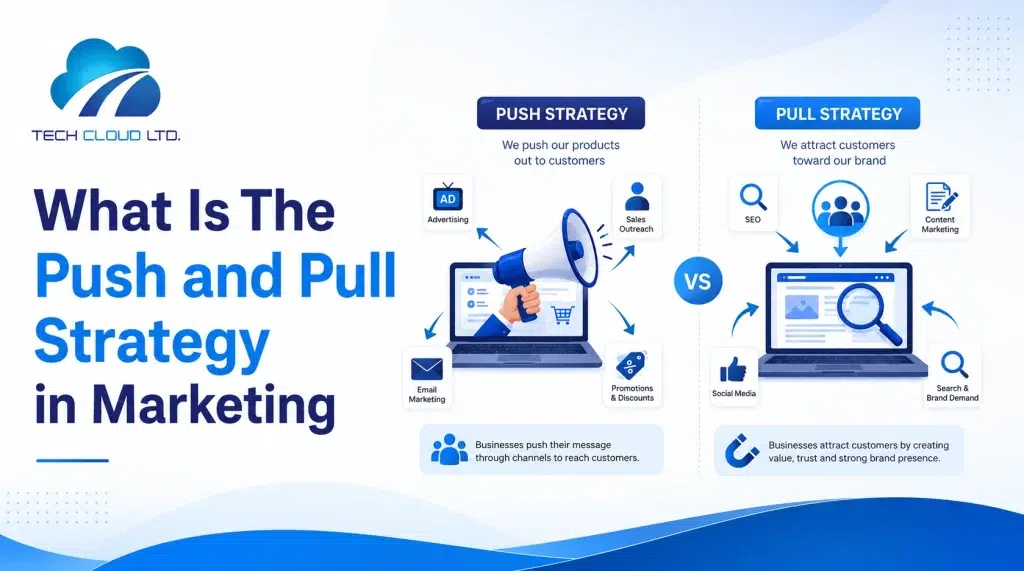
Before diving into tactics, it helps to understand the core idea behind both approaches. Push and pull marketing describe two opposite directions your message can travel, either toward the customer or from the customer toward you.
Push marketing is a strategy where a business pushes its products or messages directly toward customers, often through outbound channels, regardless of whether they are actively looking. Think cold calls, TV ads, trade promotions, and retail placement. The goal is to create demand where none existed yet.
Pull marketing works the opposite way. It attracts customers naturally by offering value-driven content and experiences, so people come looking for you. SEO, content marketing, and social media all fall under pull.
Key traits of push marketing:
- Outbound, interruption-based communication.
- Fast turnaround, quick results.
- Higher upfront cost and larger ad budgets.
- Common for new product launches.
Key traits of pull marketing:
- Inbound, permission-based communication.
- Slower, ongoing time commitment.
- Lower cost per acquisition over time.
- Builds long-term trust and loyalty.
Key Differences Between Push vs Pull Marketing
Seeing both strategies side by side makes the choice easier. Here is a direct comparison based on how each one operates in practice.
| Factor | Push Marketing | Pull Marketing |
| Direction | Outbound | Inbound |
| Speed | Fast turnaround, quick results | Ongoing, longer commitment |
| Cost | Higher cost, larger budgets | Lower cost, more time invested |
| Best for | New products, less involved purchases | High-involvement purchases, personal connections |
| Goal | Launch products, boost sales, clear inventory | Build trust, grow relationships |
| Example channels | Trade shows, direct selling, discounts | SEO, social media, influencer content |
Pull marketing also tends to outperform on efficiency. One study found pull-driven traffic converts 68% higher than push traffic, and companies focused on pull content see 434% more indexed pages. That gap alone explains why so many businesses now invest in digital marketing built around search visibility.
Goals and Tactics of Push and Pull Marketing Strategy
Each strategy exists to solve a different business problem. Push solves the “nobody knows this product exists yet” problem. Pull solves the “how do we keep people coming back” problem.
Push marketing goals and tactics:
- Launch a new product or brand fast.
- Increase short-term sales volume.
- Reduce excess inventory.
Tactics: Trade show showcases, direct sales calls, trade promotions, retailer discounts.
Pull marketing goals and tactics:
- Build customer relationships and trust.
- Increase brand loyalty and repeat purchases.
- Grow organic visibility on search engines.
Tactics: Digital marketing, Search engine optimization, influencer partnerships, viral campaigns
Pros and Cons of Push and Pull Marketing Strategy
Neither strategy is perfect on its own. Weighing the tradeoffs helps you decide where to put your next dollar.
Push Marketing Pros & Cons
| Push marketing pros: | Push marketing cons: |
| ◼ Delivers fast, visible results. ◼ Works well for brand new products with no existing demand. ◼ Gives you direct control over timing and message. ◼ Effective for clearing inventory quickly. ◼ Easy to measure short-term sales lift. | ◼ Requires large upfront ad spend. ◼ Can feel intrusive to customers. ◼ Results fade once spending stops. ◼ Less effective for high-involvement purchase decisions. ◼ Doesn’t build long-term brand loyalty on its own. |
Pull Marketing Pros & Cons:
| Pull marketing pros: | Pull marketing cons: |
| ◼ Lower cost per acquisition over time. ◼ Builds lasting trust and loyalty. ◼ Converts better, up to 68% higher conversion. ◼ Compounds over time through SEO and content. ◼ Attracts customers already interested in buying. | ◼ Takes much longer to see results. ◼ Requires consistent content creation effort. ◼ Harder to control exact timing of results. ◼ Needs ongoing investment in search engine optimization to stay visible. ◼ Less useful for urgent, short-term sales pushes. |
Best Use Cases of Inbound and Outbound Marketing
Choosing between inbound and outbound depends heavily on your product type and sales cycle. Here are scenarios where each shines.
Best push (outbound) use cases:
- Launching a brand new product with zero market awareness.
- Clearing seasonal or excess inventory fast.
- Low-involvement purchases, such as snacks or household goods.
- Entering a new retail market and needing shelf space.
Best pull (inbound) use cases:
- High-involvement purchases like cars, software, or real estate.
- Businesses relying on repeat customers and loyalty.
- Building long-term brand authority through content marketing campaigns.
- Competing in crowded markets where trust matters more than price.
Examples of Implementing Push and Pull Marketing
Real brands make these strategies easier to picture. Two of the most cited examples show exactly how each strategy plays out.
Nike runs almost entirely on pull strategy. Its “Just Do It” marketing campaigns and athlete partnerships build a brand people actively seek out, and customers wait for new releases rather than needing to be sold.
Coca-Cola, by contrast, leans heavily on push. It works with a massive network of bottlers and distributors to get product into stores, restaurants, and vending machines everywhere, ensuring the drink is always within arm’s reach.
Pepsi also runs large TV ad campaigns that directly target consumers to create demand at the shelf, a classic pull move paired with heavy push-based distribution.
Mobile phone brands like Nokia historically relied on push tactics, offering retailer subsidies to boost volume sales through stores.
Most brands today do not pick just one. In 2026, the strongest performers mix push and pull together, using push for quick wins and pull for compounding growth.
In Conclusion
Now you know what is the push and pull strategy in marketing and how each piece fits into a bigger plan. Push gets attention fast, pull keeps people coming back, and neither works well alone forever. Business owners who understand the push-and-pull marketing strategy well stop wasting their budget on the wrong channel at the wrong time. The real advantage comes from knowing exactly when to switch gears. Start small, test both, and let your data tell you where to double down.
Not sure where to start? Tech Cloud Ltd helps businesses build the pull side of that equation, through SEO, content, and local search strategies, while making sure your push spend actually lands where it counts. Contact us today!
FAQs About Push and Pull Strategy in Marketing
What is push marketing?
Push marketing is a strategy in which a business pushes its products or messages directly to customers through outbound channels such as ads, sales calls, and retail placements.
What is pull marketing?
Pull marketing attracts customers organically through content, SEO, and brand-building so they come looking for the product themselves.
Push or pull strategy: which one is more expensive?
Push marketing usually costs more upfront due to higher ad spend and larger budgets, while pull marketing costs less per acquisition but takes longer.
Should my business use one or both?
Most successful brands use both. Push handles quick sales needs; pull builds long-term trust and loyalty.
When to use pull and when to use push strategy?
Use push for new product launches or clearing inventory fast. Use pull for high-involvement purchases and building repeat customers.
How do I measure success when applying these marketing strategies?
For push, track short-term sales lift and reach. For pull, track organic traffic, conversion rate, and search engine optimization rankings over time.
Do push and pull strategies work together in the same marketing campaigns?
Yes. Many brands run push ads to launch a product while using pull content to sustain interest afterward, creating stronger overall digital marketing results.