Key Takeaways
- Traditional SEO ranks full pages for clicks; AEO structures passages so AI systems can extract, trust, and cite them in direct answers.
- A page can rank #1 on Google and still miss ChatGPT, Gemini, Claude, or AI Overview citations if claims are vague or hard to extract.
- SEO and AEO are complementary: SEO builds a crawlable, authoritative site; AEO makes the best facts reusable in answer engines.
- AEO accepts zero-click visibility; track citation share and prompt coverage alongside rankings, CTR, and sessions.
- Use one hybrid page: answer-first structure, comprehensive body, structured data, and regular fact updates.
- Do not treat answer engine optimization as a replacement for search engine optimization.
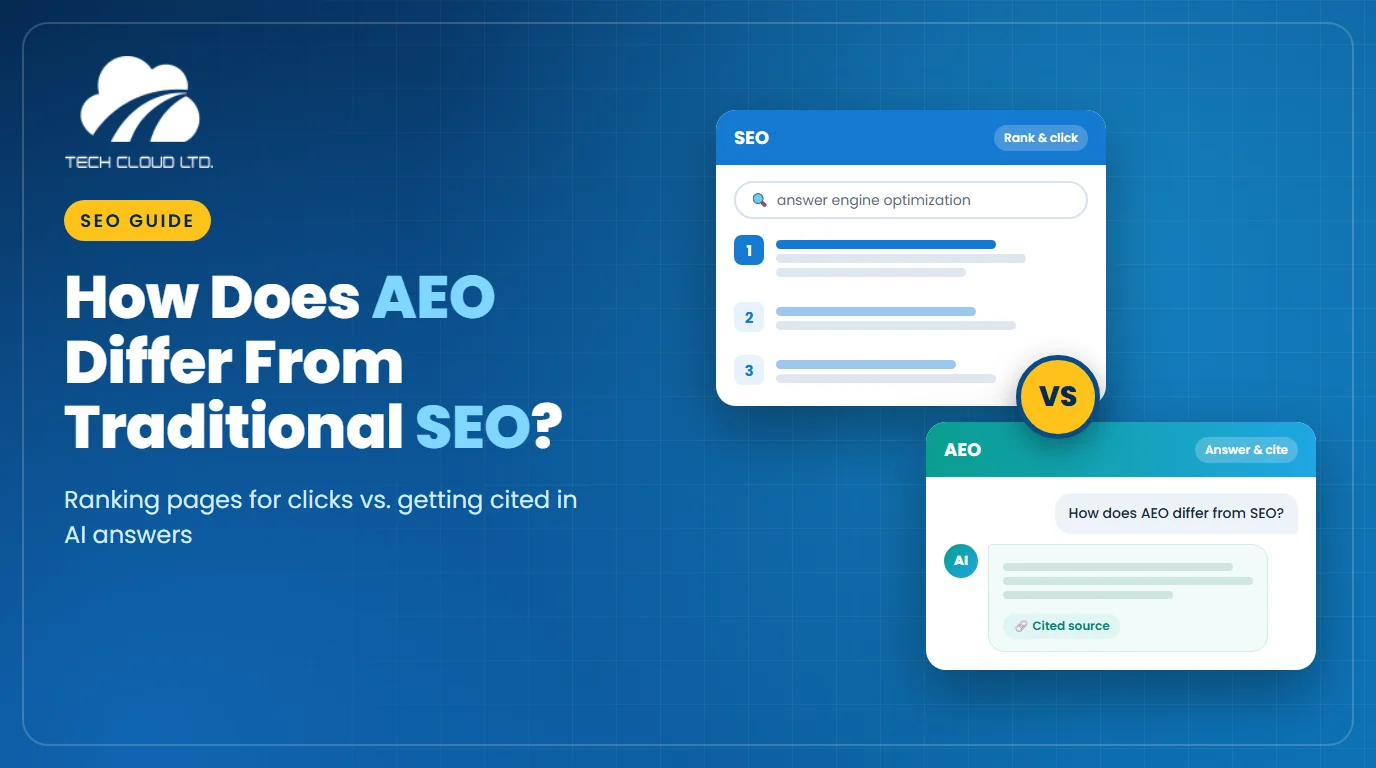
How does AEO differ from traditional SEO? Traditional search engine optimization aims to rank pages and earn clicks from search results. Answer engine optimization (AEO) aims to make a brand's information clear enough for AI systems to retrieve, cite, and use inside a direct answer.
That difference changes how content should be planned, written, structured, and measured. A page can rank well in Google yet fail to appear in ChatGPT, Gemini, Perplexity, Claude, or Google AI Overviews. It can also earn a citation without holding the first organic position for every related keyword.
The solution is not to abandon SEO. It is to build pages that work in both environments: discoverable to crawlers, valuable to readers, and easy for AI systems to verify and quote.
What is AEO vs SEO?
◾ Core difference: SEO (search engine optimization) improves how full web pages rank in classic results so users click through. AEO (answer engine optimization) structures passages so AI systems can extract, trust, and cite them as direct answers. SEO optimizes pages for discovery. AEO optimizes fragments for resolution. Both need a crawlable, authoritative site with good content.
◾ SEO and AEO in plain terms: What is SEO and AEO? In simple terms, SEO is the older discipline. It covers technical health (crawlability, speed, Core Web Vitals), on-page relevance (keywords, headings, internal links), and off-page authority (backlinks, brand mentions). AEO is newer in mainstream marketing language, though answer-focused optimization predates generative chat. It packages content for ChatGPT, Google AI Overviews, Perplexity, Gemini, Claude, Copilot, and AI voice assistants.
◾ Goals of AEO and SEO: SEO has a page-level goal. A marketer typically asks whether a URL ranks for a keyword, attracts organic visitors, and produces leads or sales. A complete guide can rank because it covers a subject better than competing pages and earns authority over time. Answer engine optimization has a passage-level goal. It structures content so an answer engine can identify a direct response, evaluate its credibility, and use it as part of a synthesized answer. This is the practical difference between AEO and SEO: a search engine may rank your entire guide, while an answer engine may use one definition, one table row, one step, or one comparison from it.
◾ Two layers of search behavior: Search behavior has split into two layers. The first layer is ranked links, still important for research comparison and conversion journeys where users need to browse options. The second layer is synthesized answers growing rapidly for quick facts, how tos recommendations, and voice interactions. Over sixty-five percent of Google searches now end without a single click because users receive complete answers directly within the search interface.
Why AEO and SEO work together
AEO and SEO are complementary, not contradictory. A solid SEO foundation is needed for AI Search Engines and Bots to retrieve information and cite it in their responses. Without a technically sound and authoritative website, a brand's content will likely never be noticed by AI models.
However, traditional SEO is not enough to get cited by AI answer engines; proper AI-friendly content is critically important. A study by Ahrefs showed that a substantial share of AI Overview citations do not simply mirror the organic top 10 as tightly as early observers expected. A page can rank #1 on Google and still miss ChatGPT, Gemini, or Claude citations if key claims are vague, buried, or hard to extract.
How does AEO differ from traditional SEO?
How does answer engine optimization differ from traditional search engine optimization? SEO tries to win a prominent place in a ranked list of web pages. AEO tries to become a trusted, extractable source inside an answer generated by AI systems. The disciplines overlap in quality and authority, but their optimization units, formats, metrics, and user journeys differ.
The difference is best understood as a shift from retrieval to resolution. Conventional search helps users find possible sources. Answer engines attempt to resolve the question before the user opens a source.
The table below shows the AEO vs traditional SEO difference in practical terms. Treat it as a planning tool, not as a claim that every platform selects sources in the same way.
| Dimension | Traditional SEO | Answer engine optimization |
|---|---|---|
| Primary objective | Rank a URL and earn qualified clicks | Earn a citation, mention, or inclusion in a direct answer |
| Optimization unit | Whole page or URL | Answer capsule, passage, fact, list, table, FAQ |
| Search behavior | “Help me find” | “Tell me what to do” |
| Query form | Short keyword phrases often dominate planning | Full questions, constraints, comparisons, follow-up prompts |
| Content structure | Comprehensive topical coverage | Direct answer first, then evidence and depth |
| Authority emphasis | Links, topical relevance, technical quality, engagement | Entity clarity, factual accuracy, source quality, corroboration, readable structure |
| Key metric | Rankings, impressions, CTR, sessions, conversions | Citation share, mention rate, prompt coverage, AI referral quality |
| Main surfaces | Google and Bing results pages | AI Overviews, AI Mode, ChatGPT, Gemini, Claude, Perplexity, AI voice tools |
| Primary risk | Low ranking or low click-through rate | Content is overlooked, paraphrased without credit, or cited without a click |
Now let's explore the difference between answer engine optimization and search engine optimization in more detail:
1. SEO optimizes pages; AEO optimizes answer units
Traditional search engines evaluate whether a page deserves to rank against other pages. AI answer engines evaluate whether a small portion of that page answers a prompt with enough clarity and trust for reuse. A strong AEO page therefore contains several self-contained answer units, not one buried conclusion.
A traditional SEO article may begin with background, define the topic in the middle, and place the best answer after several sections. That format can work for a reader who has clicked through and wants a detailed guide.
It is weaker for an answer engine. A model or AI search product needs a concise response it can extract with minimal ambiguity.
A useful AEO pattern is:
- State the direct answer in 40 to 60 words.
- Define the conditions and limits of that answer.
- Support the claim with a source, example, table, or method.
- Expand into the deeper context a serious buyer or reader needs.
For example, a section on the difference between AEO and SEO should start with the distinction itself. It should not force readers to scan 800 words before they find it.
That format also improves the human experience. Readers can decide quickly whether the page addresses their question, then continue for detail.
2. SEO seeks clicks; AEO accepts zero-click visibility
SEO treats a click as a central performance event because the website controls the conversion path after the visit. AEO recognizes that some users will receive enough information inside an AI answer, so it measures presence and citation as well as traffic.
Pew Research Center found that Google users who saw an AI summary clicked a traditional search-result link on 8% of visits, versus 15% when no AI summary appeared; nearly twice as often.
Pew also found that source links within AI summaries received clicks on only 1% of visits in its analysis. This does not mean citations lack value. A citation can create brand familiarity, validate expertise, and influence a buyer who later searches for your company directly.
However, it does mean that a content program should not count on citations alone for conversion. Give high-intent visitors a reason to click: original research, a useful template, a calculator, a product comparison, a live availability check, pricing detail, or a credible implementation guide.
3. SEO leans on keywords; AEO adds questions and entities
Keywords remain useful because they reveal demand and intent. AEO extends keyword research by mapping the full question, the user’s constraints, and the entities involved. A page that defines those relationships clearly gives an answer engine less room to misread it.
A keyword such as “AEO vs SEO” identifies the broad topic. A question such as “Should a B2B SaaS company prioritize AEO or SEO in 2027?” identifies audience, context, decision, and time frame.
Entity clarity is equally important. Define the company, product, person, location, feature, price, date, method, and limitation where relevant. Avoid claims such as “the best platform” unless the page states the evaluation criteria and evidence.
4. SEO authority is link-led; AEO trust is broader
Backlinks remain a major SEO signal because they help search engines judge authority and discovery. AEO also benefits from authority, but it places extra importance on whether the claim is precise, current, attributable, and consistent with reliable sources across the web.
A backlink from a respected publication can help a page rank and strengthen brand credibility. It does not guarantee that an AI platform will cite a particular paragraph.
Answer engines often need claims they can safely summarize. The page should show who wrote it, when it was updated, what evidence supports it, and where the boundaries are.
Pew found that Wikipedia, Reddit and YouTube were the most frequently cited sources in both AI summaries and traditional Google results in its study. The takeaway is not to copy those sites. It is that broad entity presence, community discussion, reliable reference material, and accessible formats can influence what people and systems encounter.
5. SEO measures Traffic; AEO measures visibility in AI Responses
SEO reporting measures how search listings create visits and revenue. AEO reporting measures whether a brand appears in relevant AI answers, how accurately it appears, and whether citation visibility creates qualified demand. One dashboard cannot answer both questions well.
Track SEO with organic impressions, keyword positions, click-through rate, sessions, assisted conversions, leads, revenue, and referring domains.
Track AEO with a fixed set of prompts across target platforms. Record mention rate, citation rate, answer position where visible, accuracy, competitor presence, referral traffic, and changes after a content update.
A useful measurement habit is to save the exact prompt, platform, date, location, account state, and output. AI results can vary by model, freshness, personalization, and retrieval source. A claim of “ranked first in AI” without that context has little value.
A practical dual-optimization workflow
When exploring how does AEO differ from traditional SEO, you might think they should be practiced independently. However, the best answer engine optimization vs SEO differences strategies do not create two disconnected content libraries. They create one strong page with an SEO foundation and an AEO-ready structure. The first earns discovery; the second makes the page's best evidence reusable in answer experiences.
Start with the customer question and search intent. Then identify the facts a trustworthy answer must include.
Build the page around a direct answer, detailed explanation, decision criteria, proof, limitations, examples, and next steps. Add internal links where they move the reader toward a relevant service or resource.
Refresh facts that can change. Update dates, prices, platform features, regulations, methodology, and statistics. A stale page can still rank, but stale facts weaken trust, which affects visibility in AI search engines and LLM responses.
Myths about AEO vs SEO differences
Answer engine optimization (AEO) is a fresh addition to the SEO world. As with any new concept, a lot of myths are floating around about how does AEO differs from traditional SEO. Here are the myths you should be aware of:
Myth 1: AEO Is Just SEO With A New Name
Reality: Pages that rank number one on Google are not consistently the ones cited in ChatGPT, Claude, or Gemini. Citation behavior differs per model. AEO shares SEO’s technical and quality foundations, but the success event differs.
SEO focuses on page rankings and traffic. In contrast, AEO focuses on answer inclusion, citations, and visibility across all AI search and generative engine platforms, not limited to just traditional search engines.
Myth 2: AEO replaces SEO
Reality: They are complementary layers. SEO supplies the crawlable, authoritative corpus answer engines can retrieve. Ranked organic search still drives research journeys, comparison shopping, and revenue. AEO extends visibility into interfaces where users may never open a blue link. Replacement talk ignores transactional and local paths that still need pages, packs, and clicks.
Myth 3: Backlinks Do Not Matter Anymore
Reality: Links still support discovery, authority, and traditional rankings. AEO adds other trust requirements: precise claims, credible evidence, consistent entity details, named expertise, and freshness. For answer engines, they matter as credibility and entity signals. They weigh less as a pure volume game than in classic SEO. Cross-source factual agreement and recognized brand entities often decide citation more than a raw referring-domain count. Keep building real authority. However, don't assume link velocity alone buys AI mentions.
Myth 4: Same Content Works For Both
Reality: Sometimes but not by accident. Requires a deliberate dual structure: front-loaded answers plus claim density plus schema plus depth. A page written purely for rankings buries the answer under context. A page written purely for AEO lacks the topical comprehensiveness that builds topical authority. The hybrid template is an answer capsule, then a detailed body, then structured data.
Final Words
How does AEO differ from traditional SEO? SEO helps people and crawlers discover a useful page. AEO helps AI systems identify the exact parts of that page that answer a question clearly and credibly. They are two layers of the same visibility strategy. Do not choose one and neglect the other.
Build technically sound pages with real expertise, then structure the strongest facts so they are easy to find, understand, verify, and cite. If you need assistance regarding SEO and AEO, we can help. Tech Cloud Ltd has a world-class team of experienced SEO specialists and copywriters who can help you get the visibility you want with both traditional search engines and answer engine platforms. Contact us today to get started.
FAQs about the difference between AEO and SEO
How do AEO strategies differ from SEO strategies?
AEO strategies focus on concise answer blocks, question-led headings, factual precision, structured content, entity clarity, and citation monitoring. SEO strategies focus more on crawlability, keyword relevance, rankings, internal links, backlinks, and organic traffic.
How much overlap is there between SEO and AEO?
The overlap is substantial. Both need technically accessible, accurate, authoritative content, but AEO adds optimization for AI synthesis, attribution, and prompt-level visibility.
What are the key deliverables of an AEO and SEO?
SEO deliverables include keyword maps, technical audits, optimized pages, internal-link plans, backlink work, and reporting. AEO deliverables include prompt maps, answer capsules, structured content, entity audits, citation tracking, and AI-answer tests.
Will answer engine optimization replace SEO?
No. AEO does not replace SEO because answer engines still rely on accessible, credible web information. The two disciplines work best as complementary layers.
Can I optimize one page for both SEO and AEO?
Yes. Put a concise direct answer near the top, then add comprehensive evidence, examples, internal links, and conversion elements. This “answer first, depth second” structure supports both goals.
Do I need AEO if I already do SEO?
Yes, if customers use AI search engines, AI chatbots, or voice assistants in your market. SEO can make you discoverable; AEO improves your ability to appear when users ask for a direct answer.